


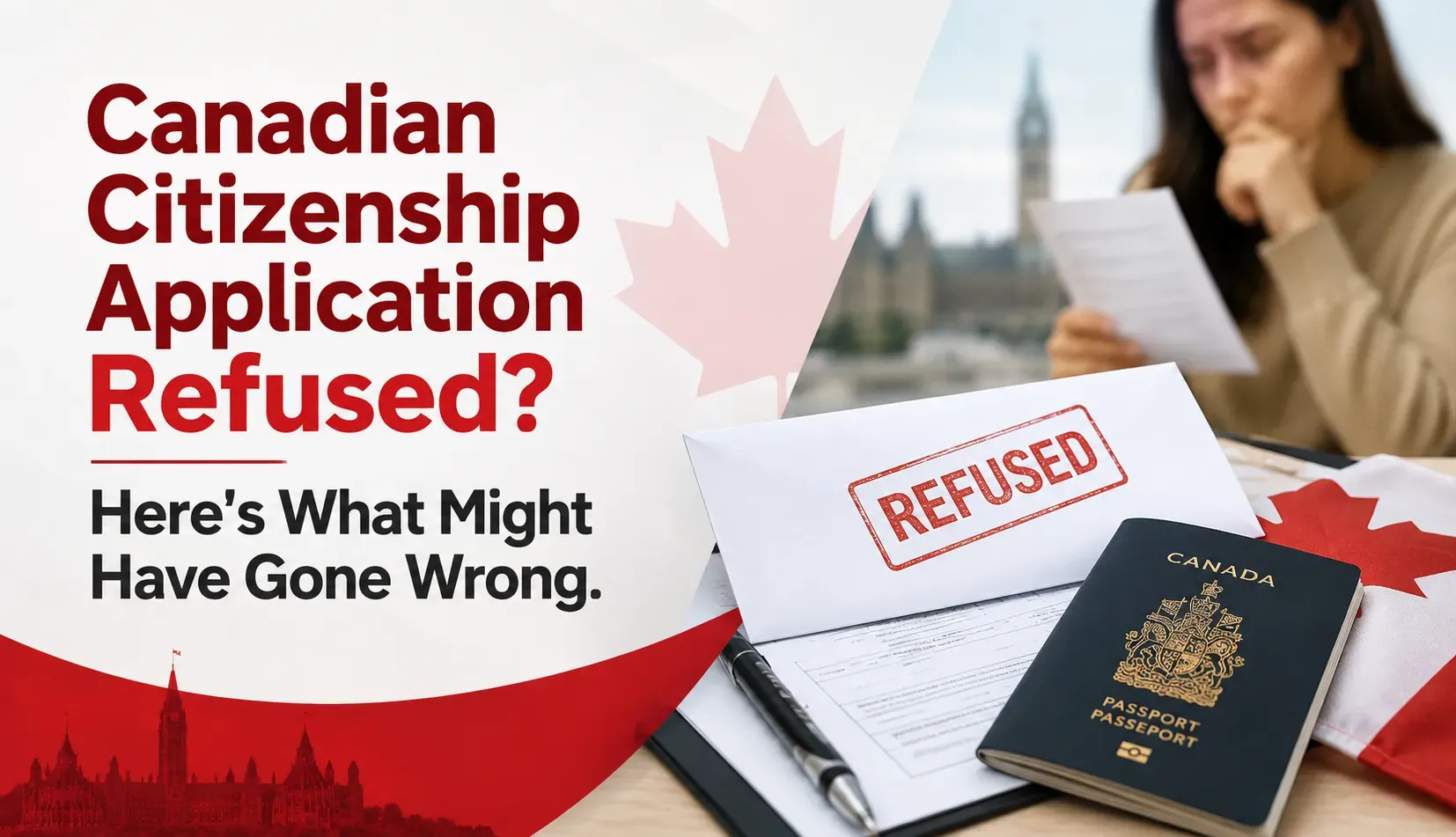

Canadian Citizenship Application Refused? Here’s What Might Have Gone Wrong
Applying for Canadian citizenship is a big step. Many permanent residents wait for years to reach this point. They prepare documents, count their days in Canada, study for the citizenship test, and hope to receive approval. So, when a citizenship application gets refused, it can feel stressful and confusing.
A refusal does not always mean your dream of becoming a Canadian citizen is over. It often means something went wrong in the application, documents, eligibility, or process. Many people face Refused Applications in Canada because they miss small details or do not understand the full citizenship requirements.
In this blog, we will explain the common mistakes that may lead to a refused Canadian citizenship application. We will also discuss key Immigration Refusal Reasons in simple language so you can better understand what may have happened and what steps you can take next.
What Does a Refused Citizenship Application Mean?
A refused citizenship application means Immigration, Refugees and Citizenship Canada, also known as IRCC, did not approve your request to become a Canadian citizen. This can happen for many reasons.
IRCC may refuse your application if you do not meet the citizenship rules, if your documents are not complete, or if the officer finds a serious issue in your file. Some refusals happen because of missing proof. Others happen because of eligibility problems.
Many Refused Applications in Canada happen when applicants apply too early or submit information that does not match their records. That is why it is important to review every detail before sending an application.
Common Reasons Your Citizenship Application May Be Refused
Citizenship applications need careful attention. Even a small mistake can create delays or lead to refusal. Below are some of the most common Immigration Refusal Reasons for citizenship applications in Canada.
1. You Did Not Meet the Physical Presence Requirement
To apply for Canadian citizenship, most adult applicants must show that they have lived in Canada for enough days during the required period. Many applicants make mistakes when they calculate their physical presence.
You may forget short trips outside Canada. You may enter the wrong travel dates. You may count days that do not qualify. These errors can affect your total number of days.
This is one of the common causes of Refused Applications in Canada. IRCC checks your travel history carefully. If your physical presence does not meet the rule, the officer may refuse your application.
2. Your Permanent Resident Status Had Problems
You must be a permanent resident to apply for Canadian citizenship. If your PR status has issues, your citizenship application may face problems.
For example, if you are under a removal order, you may not qualify. If there are questions about your residency obligations or your status in Canada, IRCC may need more information.
Applicants should always make sure their PR status is clear before they apply. Problems with status are one of the serious Immigration Refusal Reasons because citizenship depends on your legal position in Canada.
3. You Submitted Incomplete Documents
IRCC needs complete and correct documents to process your application. If you miss a document, send unclear copies, or upload the wrong file, your application may not move forward.
Common document mistakes include:
- Missing ID proof
- Missing language proof
- Incorrect travel history
- Unclear copies of documents
- Wrong form version
- Missing signatures
- Incomplete answers
Incomplete paperwork is one of the biggest reasons for Refused Applications in Canada. Many applicants focus only on the main form and forget supporting documents. But every document matters.
4. Your Language Proof Did Not Meet the Requirement
Some adult applicants must prove that they can speak and listen in English or French at the required level. If your language proof does not meet the rule, IRCC may refuse or return your application.
You may face problems if your language result is not accepted, cannot be verified, is not clear, or does not show the required skill level.
Language proof is one of the common Immigration Refusal Reasons for citizenship applicants. Always check that your document meets IRCC’s rules before you apply.
5. You Failed the Citizenship Test or Interview
Many applicants between certain age groups need to take the citizenship test. This test checks your knowledge of Canada, including rights, responsibilities, history, geography, government, and laws.
If you fail the test, IRCC may give you another chance or invite you for a hearing, depending on your case. If you still do not meet the requirement after the process, IRCC may refuse your application.
This can become one of the more stressful Immigration Refusal Reasons because many applicants feel nervous during the test or interview. Good preparation can help reduce this risk.
6. You Did Not File Taxes When Required
Some applicants must show that they filed income taxes in Canada for the required years. If you needed to file taxes but did not, this may affect your citizenship application.
IRCC may compare your tax details with your application. If your information does not match, the officer may ask questions.
Tax-related issues can lead to Refused Applications in Canada, especially when applicants do not understand which years they must report. Before applying, it is helpful to review your tax filing history.
7. You Gave Incorrect or Inconsistent Information
Your citizenship application must be honest and accurate. IRCC may compare your details with past immigration applications, travel records, tax records, and other documents.
Problems may happen if:
- Your travel dates do not match
- Your address history is incomplete
- Your work or study history has gaps
- Your family information is different from past forms
- Your documents show conflicting details
Incorrect information is one of the most serious Immigration Refusal Reasons. Even if the mistake was not intentional, it can still create problems. If IRCC thinks the information is false or misleading, the issue can become more serious.
8. You Missed an IRCC Request or Appointment
IRCC may contact you during the citizenship process. They may ask for more documents, invite you to a test, schedule an interview, or request fingerprints.
If you do not reply on time, your application may be delayed, closed, or refused. Sometimes applicants miss emails because they do not check their online account or spam folder.
This is another common reason behind Refused Applications in Canada. Always monitor your email and IRCC account after you submit your application.
9. You Had Criminal or Legal Issues
Certain criminal or legal situations can stop a person from becoming a Canadian citizen. For example, being charged with a serious offence, serving a sentence, being on probation, or having certain convictions may affect your eligibility.
Legal issues are complex, so applicants should not guess. If you have any criminal or court history, you should understand how it may affect your citizenship application before you apply.
This is one of the strongest Immigration Refusal Reasons because IRCC must make sure applicants meet the legal requirements for citizenship.
10. You Applied Too Early
Some applicants apply before they fully qualify. They may think they have enough days in Canada, but after proper calculation, they fall short. Others may apply before they meet tax, language, or eligibility requirements.
Applying too early can waste time and money. It can also lead to avoidable stress. Many Refused Applications in Canada happen because applicants rush the process without checking every requirement first.
What Should You Do After a Citizenship Refusal?
A refusal can feel disappointing, but you should stay calm. Start by reading the refusal letter carefully. The letter should explain why IRCC refused your application.
Review the Refusal Letter
Read every line of the letter. Look for the exact reason IRCC gave. Do not assume the problem. Sometimes the issue is simple. Other times, it may need careful review.
Check Your Documents Again
Compare your submitted documents with the citizenship checklist. Check your forms, travel history, tax records, language proof, and ID documents.
Fix the Main Problem Before Reapplying
If you still want to apply for citizenship, fix the issue first. Do not send the same application again without changes. If the same problem remains, IRCC may refuse it again.
Get Professional Guidance If Needed
If your case involves legal issues, misrepresentation concerns, unclear refusal reasons, or complicated travel history, professional help can make the process easier to understand.
How to Reduce the Risk of Refusal
You can reduce the risk of refusal by preparing carefully before you apply.
Use a Checklist
Follow the official checklist and make sure every document is complete.
Count Your Days Carefully
Review every trip outside Canada. Make sure your physical presence calculation is correct.
Keep Your Information Consistent
Use the same names, dates, addresses, and details across all documents.
Prepare for the Test
Study early and understand the citizenship test topics.
Reply to IRCC Quickly
Check your email and online account often. Respond before the deadline.
Final Thought
A refused citizenship application can feel upsetting, but it does not always end your journey. Many refusals happen because of missing documents, incorrect details, early applications, or unclear eligibility. When you understand what went wrong, you can take better steps before applying again.
ZF Canada helps applicants understand the process in a simple and practical way. If your Canadian citizenship application was refused, take time to review the reason, correct the mistake, and prepare your next step with care. A strong and complete application can improve your chances of moving forward with confidence.






Leave A Comment
You must be <a href="https://zfcanada.com/wp-login.php?redirect_to=https%3A%2F%2Fzfcanada.com%2F2026%2F06%2F08%2Fcanadian-citizenship-refused%2F">logged in</a> to post a comment.